Restorative Justice and Healing
A Path Forward
An indistinct destination, on a necessarily long and circuitous journey (Zehr, Changing Lenses, 2015). Widely known as “the grandfather of restorative justice,” Zehr began as a practitioner and theorist in restorative justice in the late 1970s and has led hundreds of events around the world, including trainings and consultations on restorative justice, victim-offender conferencing, judicial reform, and other criminal justice matters. More about Zehr, his global work and the Zehr Institute at Eastern Mennonite University, can be found here:
I’ve been inspired by the work of Retired Wisconsin State Supreme Court Justice Janine Geske and Father Daniel Griffith in the application of restorative practices in the Catholic Church. That has led me to want to learn more, a search that led me to the Center for Justice and Peacebuilding program at Eastern Mennonite University (EMU). I’m particularly interested in the intersection of faith and justice. Professor Johonna Turner, in a lecture in my Restorative Justice course at EMU, described the connections this way: “Faith-based Restorative Justice practitioners learn to activate their potential to build bridges across the deep philosophical and religious divides.”
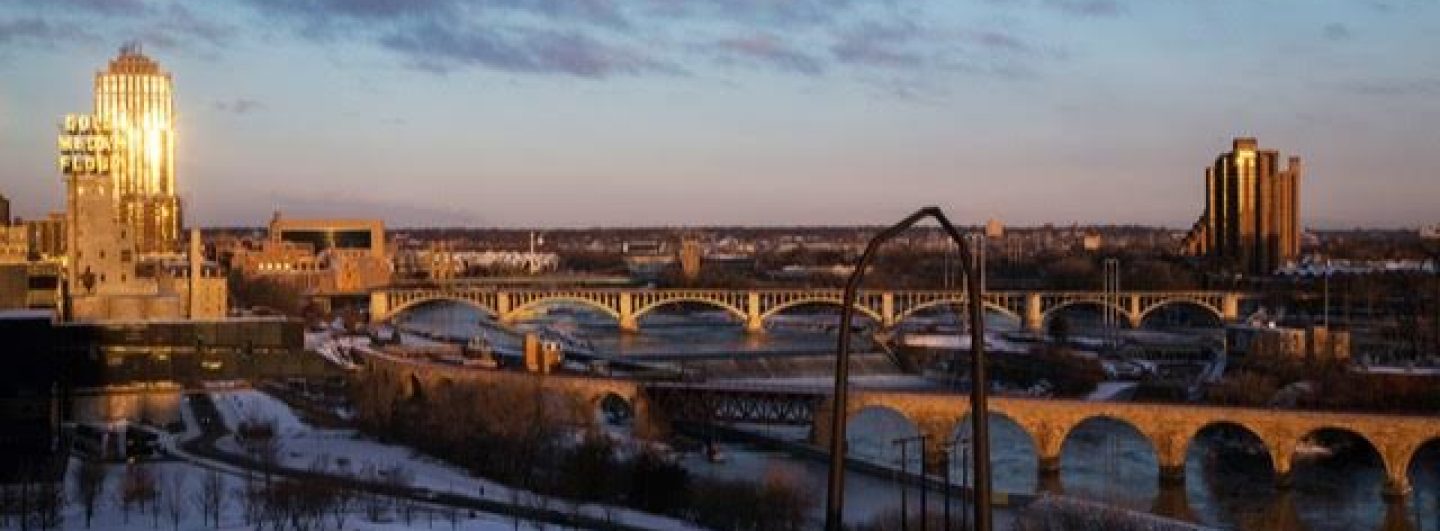
I love the image above for several reasons: it is the work of a talented friend, Ric Rosow, it depicts a somewhat indistinct destination (the Mississippi River in our neighborhood, downtown Minneapolis) and it indeed has bridges. After having been involved in hundreds of websites for a range of other purposes, this is my first personal blog. It will be a place to chronicle what I’ve learned in what has become a second career and a calling. The journey began with this work:
The Archdiocese of St. Paul and Minneapolis
In the past decade, this archdiocese was charged with failure to protect children, saw the resignation of the archbishop and filed for bankruptcy. The direct harm to victims and the peripheral harm to the community has been manifold and deep.
The Twin Cities
Minneapolis and St. Paul experienced a reckoning in the summer of 2020. George Floyd’s killing held up the mirror of systemic racism. The Minnesota Peacebuilding Institute and Coming to the Table were in conversation before that event, and were prepared to respond.
Eastern Mennonite University
When I began to explore pursing an academic program in restorative justice, all roads led to Harrisonburg, Virginia.
A justice that seeks not to punish, but to heal. A justice that is not about getting even, but about getting well.
Kay Pranis
Inspiring friends in West Virginia
As we wrap up four days of virtual training with the team at RJWV.org, I’m looking back at a couple of years ago when we received the first phone call from Jamey Brogan. As Jamey described the situation in their local diocese, the parallels to our situation in the Twin Cities were unmistakeable – significant…

A connecting space that holds our differences, differently
I circled back to my classmate Eric Paul to make sure I attributed this quote correctly. I love this description of Restorative Justice – “a connecting space that holds our differences, differently.” Eric included it in his final presentation, which was titled, “Can the Church be Trusted with Justice?” What an exceptionally well done presentation.…
“Is Restorative Justice Appropriate for Faith Community Discussions About Racism?”
My thesis paper for PAX 571 Restorative Justice: Principles, Theories and Applications is submitted. The PowerPoint for presentation is roughed out and I’ve watched the videos that describe how to create and add a video on VoiceThread. I mentioned to a few folks that the paper almost killed me. Well, not literally of course, (I’m…
Julie Henderson Craven
215 10th Avenue South, Unit 1014 Minneapolis, MN 55415
julie.h.craven@gmail.com
 An Indistinct Destination